

Reverse Shoulder Replacement
Reverse shoulder replacement treats severe shoulder arthritis associated with irreparable rotator cuff damage. In this condition, the rotator cuff no longer stabilizes or lifts the arm effectively. As a result, patients experience weakness, pain, and loss of elevation. This procedure shifts the mechanics of the shoulder so that the deltoid muscle restores movement.
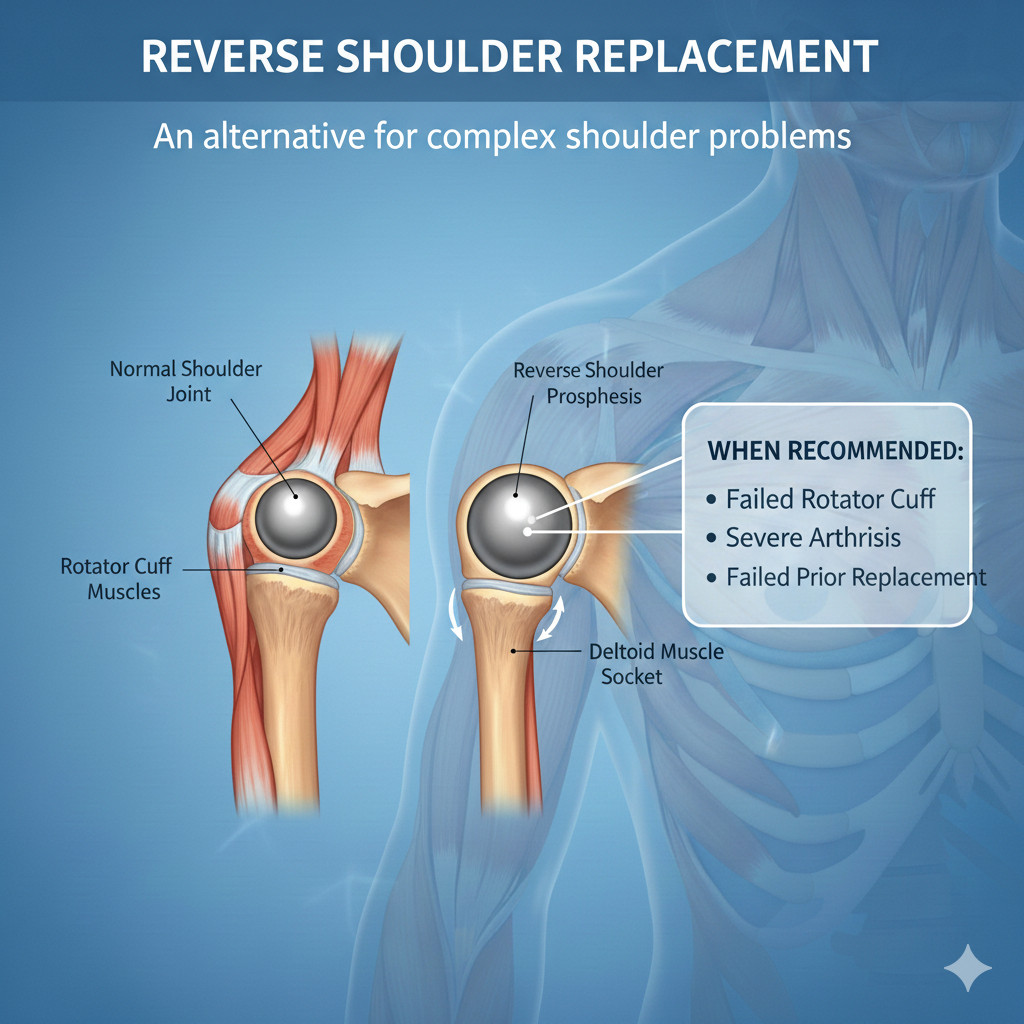
Why This Surgery Is Needed
In a healthy shoulder, the rotator cuff stabilizes the joint and assists with arm elevation. However, large or chronic tendon tears disrupt this balance and lead to pain, weakness, and instability.
Traditional shoulder replacement relies on an intact rotator cuff. Without it, the implant cannot function properly and outcomes remain limited. Therefore, reverse shoulder replacement modifies joint mechanics to overcome this deficiency.
How the Reverse Implant Works
During the procedure, the surgeon reverses the normal ball-and-socket anatomy. Specifically, a metal ball is attached to the shoulder blade, while a socket component is fixed to the upper arm bone.
This change shifts the center of rotation medially and inferiorly. Consequently, the deltoid muscle takes over the primary role of lifting the arm. Even when the rotator cuff cannot be repaired, patients can regain functional elevation.
Who Benefits Most
Doctors recommend reverse shoulder replacement for carefully selected patients, particularly those with:
- Cuff tear arthropathy
- Massive irreparable rotator cuff tears
- Complex fractures in older adults
- Failed previous shoulder replacement
- Chronic instability with severe soft-tissue damage
Typical Symptoms
Patients commonly report:
- Severe shoulder pain
- Inability to lift the arm
- Marked weakness during overhead activity
- Persistent dysfunction after prior surgery
- Difficulty performing daily tasks
Preoperative Evaluation
The surgeon conducts a detailed clinical examination and reviews imaging studies to assess bone quality and soft tissue integrity. In addition, this evaluation determines implant selection and surgical strategy.
Proper patient selection and meticulous planning significantly improve long-term stability and implant performance.
The Surgical Procedure
During surgery, the surgeon removes damaged joint surfaces and implants specialized reverse components. Accurate positioning and balanced soft tissues enhance joint stability and functional durability.
Modern implant designs further aim to restore controlled motion while minimizing complications.
Rehabilitation and Recovery
Recovery progresses in structured phases. Initially, the shoulder remains protected to allow soft tissue healing. Subsequently, physiotherapy strengthens the deltoid muscle and gradually restores motion.
Consistent rehabilitation prevents stiffness and supports safe functional recovery.
Expected Results
Most patients experience significant pain relief and improved ability to perform daily activities. Although full normal motion may not return, independence and functional confidence typically improve.
Regular follow-up and structured therapy help maintain long-term stability.
Our Approach
Treatment emphasizes safety, stability, and predictable recovery through:
- Comprehensive surgical planning
- Precise implant positioning
- Restoration of joint biomechanics
- Guided postoperative rehabilitation
Goal
Restore arm elevation, improve shoulder strength, and significantly reduce pain to enhance overall quality of life.
